Invention #1003 THE FIRST COMPUTER
A step up from calculation to computation

BACKGROUND
The 18th century saw significant engineering advancements, yet the mechanical calculators of the era, inspired by pioneers like Pascal and Leibniz, were more about refinement, than revolution. While innovators like Giovanni Poleni and Philipp Matthäus Hahn made notable contributions to these machines, they were limited by the manufacturing precision of the time and were still primarily designed for specific arithmetic tasks. The complexity of creating accurate astronomical and navigation tables, coupled with the demands of the Industrial Revolution, highlighted the pressing need for automated, error-free computational methods. Manual calculation limitations further highlighted the need for automated computational methods, paving the way for Charles Babbage (1791-1871), known and regarded as the father of the computer to innovate the concept of a calculator to a computing engine.
A TIMELINE OF COMPUTATIONAL PROGRESS
1820 Arithmometer → 1822 Difference Engine → 1834 Analytical Engine
1820: The Arithmometer, created by Charles Xavier Thomas de Colmar, became the first commercially successful mechanical calculator for basic arithmetic.
1822: Charles Babbage proposed the Difference Engine, a machine to compute polynomial tables automatically.
1834: Babbage envisioned the Analytical Engine, the first design of a general-purpose programmable computer.
THE DIFFERENCE ENGINE
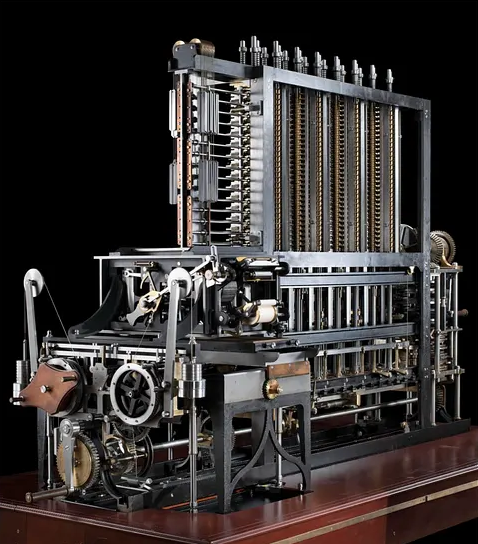
Babbage’s journey began with an earlier, less ambitious concept: the Difference Engine. Its sole purpose was to automatically calculate and print mathematical tables using the method of finite differences, a technique for approximating polynomial functions. This was a revolutionary idea, as it aimed to eliminate human errors that were rampant in the manual transcription of these tables.
The engine didn’t multiply or divide directly. Instead, the method broke complicated functions into repeated subtraction steps.
First Difference: Calculate the difference between consecutive function values.
Second Difference: Calculate the difference between consecutive "first differences."
Stability: For any polynomial, if you keep taking these differences, you will eventually reach a row of constant, unchanging values. For a quadratic function, the second difference is constant. For a cubic function, the third difference is constant, and so on.
For example, let's calculate the values of f(x) for a simple quadratic function
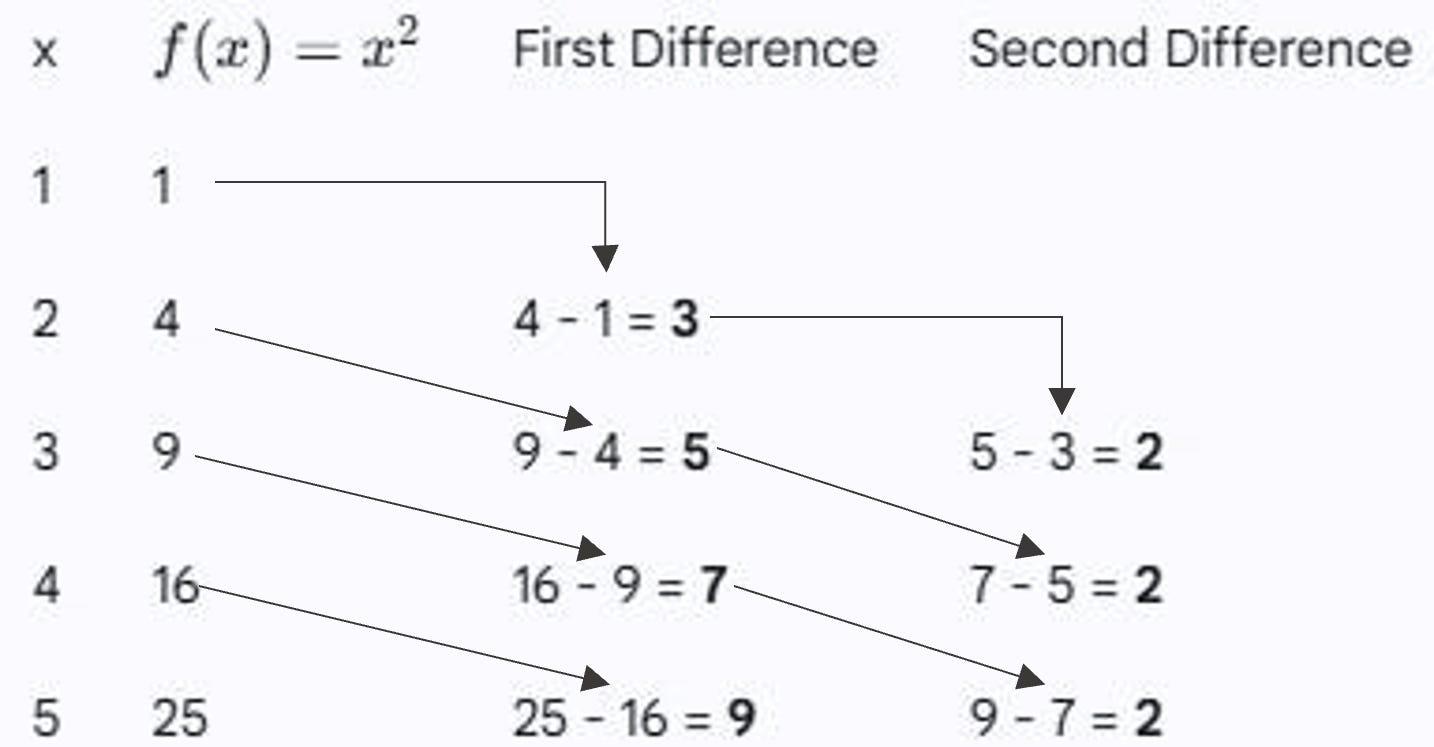
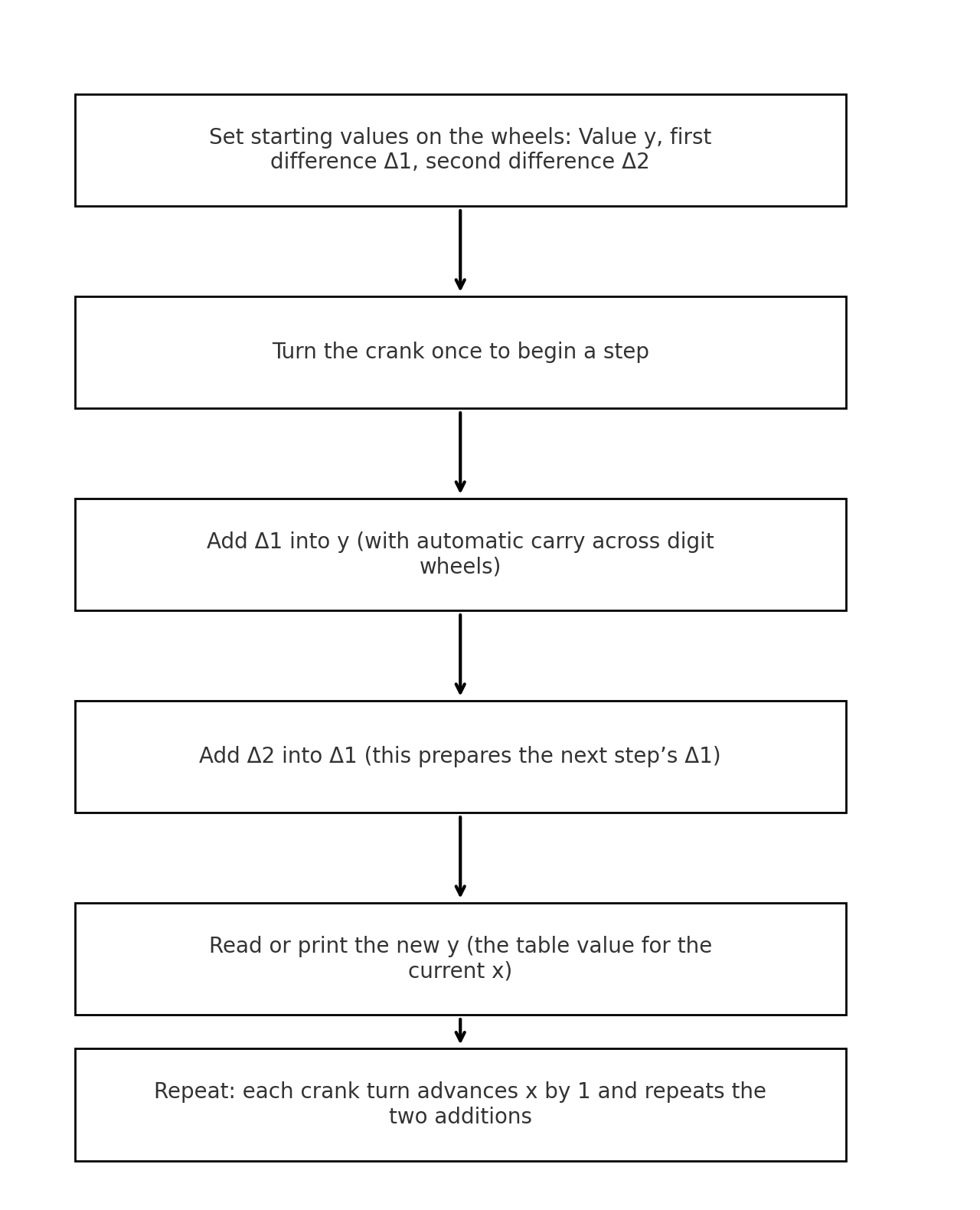
Notice that for the above quadratic polynomial, the Second Difference is always a constant value of 2. The machine will use this constant to REVERSE ENGINEER and generate the rest of the table. The flowchart below breaks down the difference engine module.
THE ANALYTICAL ENGINE
Around 1834, Babbage moved on to his most profound invention, the Analytical Engine. This was the first design for what we would now call a general-purpose programmable computer. Unlike the Difference Engine, which could only perform one type of calculation, the Analytical Engine was designed to be instructed to perform any calculation or sequence of operations that could be expressed as an algorithm.
Due to its groundbreaking features, the analytical engine became a generalized solution for computation. The features included:
Programmability: Babbage envisioned using punched cards, an idea inspired by the Jacquard loom to input programs and data, allowing the machine to be reconfigured for different tasks.
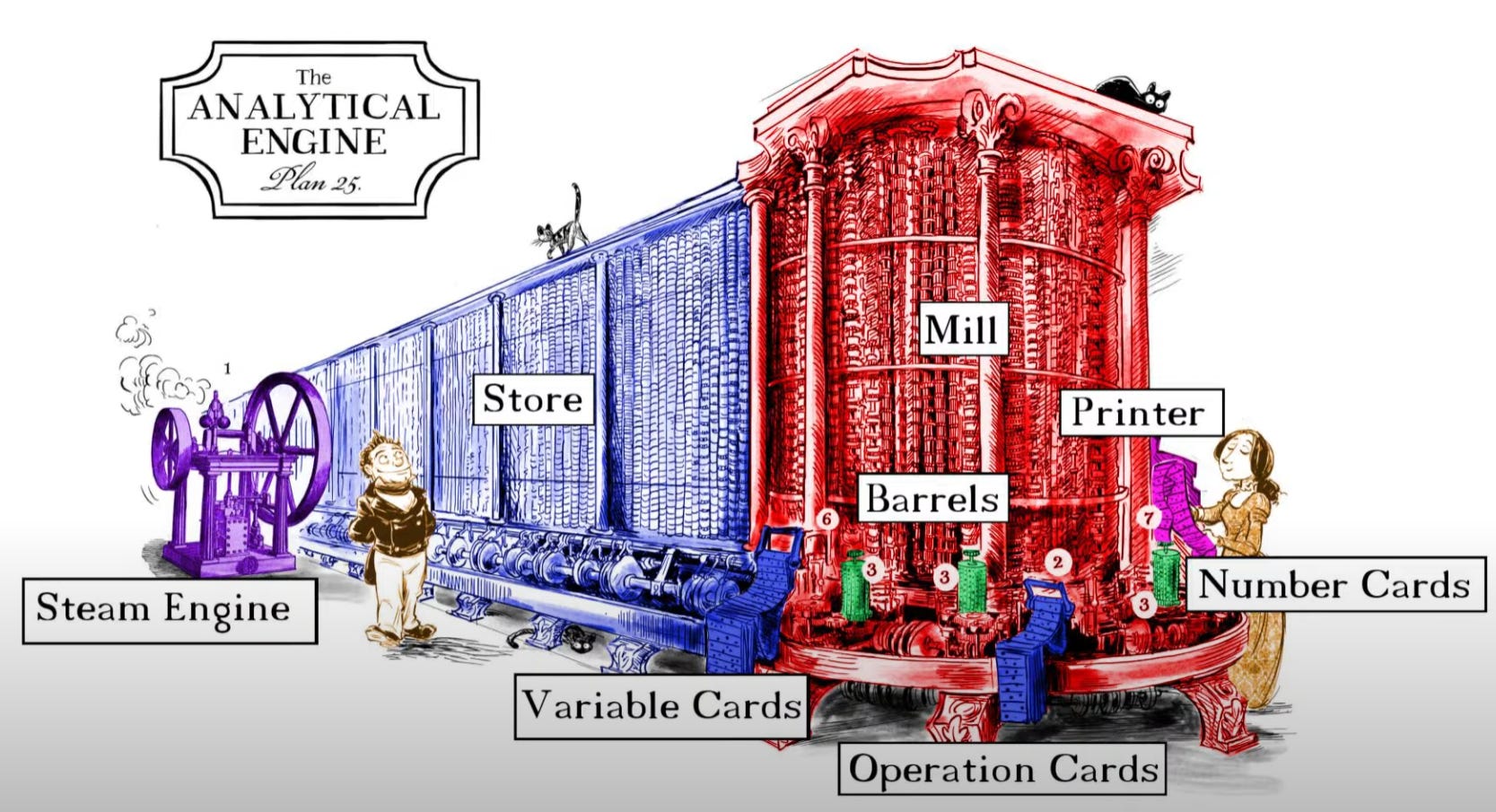
Memory and Processor: The machine had distinct components analogous to a modern computer. A "mill" performed the calculations, while a "store" functioned to hold numbers and intermediate results. The “barrels” that contained smaller steps that implemented the arithmetic operation. The "mill" later became known the central processing unit, "store" functioned as the read/write memory, “barrels” stored the microprogram which can be considered equivalent to a modern day software implementation.
Conditional Logic: Babbage's design included the ability to perform conditional branching and loops, fundamental concepts of modern programming that allow a program to make decisions and repeat actions.
Babbage’s collaborator, the brilliant mathematician Ada Lovelace was the daughter of poet Lord Byron. Working with Babbage, she wrote extensive notes on the Analytical Engine and recognized something even Babbage had not fully articulated: the machine could manipulate symbols, not just numbers.
She wrote what is considered the first algorithm intended for a machine, making her the world’s first computer programmer. Lovelace envisioned that the machine could create music, graphics and more, decades before computers became reality.
The machine was imagined as a massive combination of engines, requiring a strong steam engine to power it. The program is split into two parts encoded on punched cards. "Operation Cards" define the arithmetic instructions (addition, subtraction, multiplication, and division) to be performed. "Variable Cards" contain the load and store instructions to transfer numbers between the "Store" and the "Mill".
Key Components & Their Modern Equivalents:
Mill: The central calculating unit, which today we would call the CPU (Central Processing Unit).
Barrels: These store the microprogram, which contains the smaller operations that implement the main arithmetic functions.
Store: The read-write memory of the machine, capable of storing 1,000 decimal numbers, each with 50 digits. Each number is stored on a stack of 50 gears.
Number Cards: These are used to load initial input data or constants into the Store, similar to typing numbers on a modern keyboard.
Printer: The primary output device, which also served the function of a monitor.
Steam Engine: The power source, replaced by electricity in modern computers.
Architecture: The Analytical Engine follows a Harvard architecture, where the program and data are stored separately. This is in contrast to the von Neumann architecture, which became more common later. The Mark I, one of the first computers with a Harvard architecture, was built about 100 years after Babbage's invention.
While Babbage's ambitious machines remained largely unbuilt, their conceptual brilliance laid the theoretical groundwork for modern computing. His ideas shifted the paradigm from simple mechanical calculators to machines capable of complex, automated, and programmable computation.
MECHANICAL TO ELECTRONIC COMPUTATION
Babbage's designs were limited by the physical constraints of mechanical gears and levers. However, the discovery of electricity around the 19th century and the subsequent invention of devices like the battery and capacitor provided the necessary leap to move computing from a mechanical to an electronic device. Initially, these electrical sources were used to power electromechanical computers that still had moving parts and relays.
The true revolution came with the invention of the vacuum tube, which could act as a fast electronic switch without any moving components. This led to the first all-electronic computers like the ENIAC and Colossus during World War II. Later, the invention of the transistor and then the integrated circuit allowed for the miniaturization and increased speed that led to the personal computers we use today. The shift from mechanical gears to electrical signals was the foundational change that enabled computing to become a ubiquitous technology.